Hermes v2026.4.30 Update: Autonomous Curator, Self-Improvement & Multi-Platform Integration
Hermes v2026.4.30 (2026-04-30) update: Hermes Agent v0.12.0 (2026.4.30)
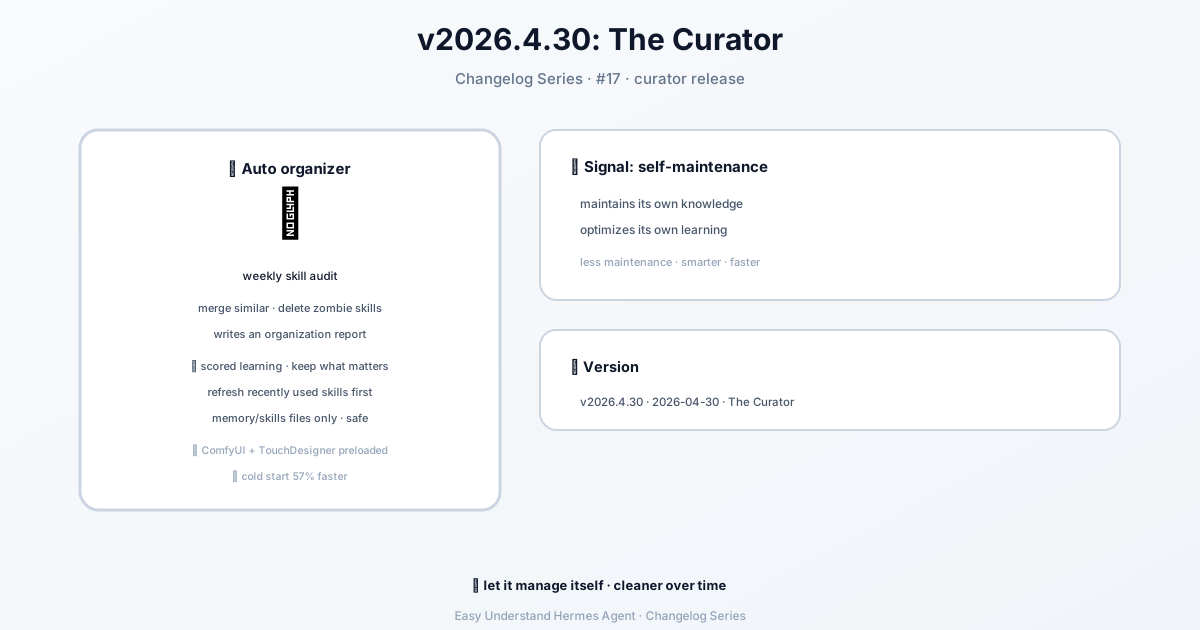
The Curator release is here — Hermes Agent can now clean up after itself, learn from its own experience, and plug into more of your daily tools than ever before.
🧹 What’s New: The Autonomous Curator
Think of your Hermes skill library as a messy desk. Over months, you pile up notes, half-finished templates, and outdated cheatsheets. Normally, you’d have to sort through it manually — but now Hermes does it for you.
The new Autonomous Curator runs in the background (once a week by default). It grades every skill you’ve saved, merges similar ones, deletes dead ones, and writes a report so you can see exactly what it did. You can check its status anytime with hermes curator status to see which skills you use most (and least).
Don’t worry — it has safety guards. Skills that came bundled with Hermes or from the official hub are protected from any changes. You can also pick which AI model the Curator uses, right from the dashboard.
Analogy: It’s like having a personal librarian who quietly reorganizes your bookshelf every Sunday, labels what’s worth keeping, and tosses the duplicates — without ever touching your rare first editions.
🧠 Improvements: A Smarter Self-Improvement Loop
Hermes already had a “self-review” feature — after each conversation, it decides what to remember or update. That loop got a major upgrade:
- Rubric-based grading instead of free-form guesswork (more consistent decisions)
- Prefers updating the skill it just used — so knowledge stays fresh where it matters
- Handles sub-files like
references/andtemplates/properly - Inherits your real runtime settings (provider, model, credentials) — no more mismatched context
- Restricted to memory and skills tools — it can’t go rogue and start doing other tasks
- Cleaner context — it no longer sees clutter from previous turns
Analogy: Before, the self-review was like a student guessing what to highlight in a textbook. Now it follows a clear syllabus, focuses on the chapter you just read, and uses your actual highlighter — not a borrowed pen.
🔌 Integrations: More Tools, Built-In
Two big integrations moved from “optional” to “bundled by default”:
- ComfyUI v5 — for AI image generation workflows, now with a proper CLI and REST API. If you have the hardware, it installs locally with GPU detection.
- TouchDesigner-MCP — for real-time visual programming and interactive media.
Plus, Hermes now natively supports:
- Spotify (control playback, search, playlists)
- Google Meet (join, schedule, transcribe meetings)
- Four new inference providers (more choices for running your models)
- 18th messaging platform overall, plus a 19th via Teams plugin
⚡ Performance & Fixes
- ~57% faster cold start for the TUI (text interface) — you’ll notice it feels snappier
- Memory providers now shut down cleanly (no more zombie processes)
- Fixed context pollution in self-review summaries
- 1,096 commits, 550 merged PRs, and 213 community contributors helped make this happen
🎯 What This Means for You
If you’ve been using Hermes for a while, this release saves you real time: your skill library stays organized without your input, your agent learns more reliably from each interaction, and you can now connect it to Spotify, Meet, ComfyUI, and more — all out of the box. If you’re new, this is a great moment to start: the setup is smoother, the defaults are smarter, and the agent is more self-sufficient than ever.
Bottom line: Hermes is becoming less of a tool you babysit and more of a partner that maintains itself — so you can focus on the work that actually needs you.
📎 Official release notes: https://github.com/NousResearch/hermes-agent/releases
📖 Official Docs
This article is based on the official Hermes Agent documentation:GitHub ›/releases/tag/v2026.4.30