Hermes Roadmap: Making AI Memory Visible and Controllable
Hermes official roadmap part 5: memory inspection and context governance — see, control, and audit what the agent remembers.
Imagine your assistant has a notebook where they jot down everything about you—but you’ve never once been allowed to open it.
What this direction is: a transparent fishbowl for AI memory
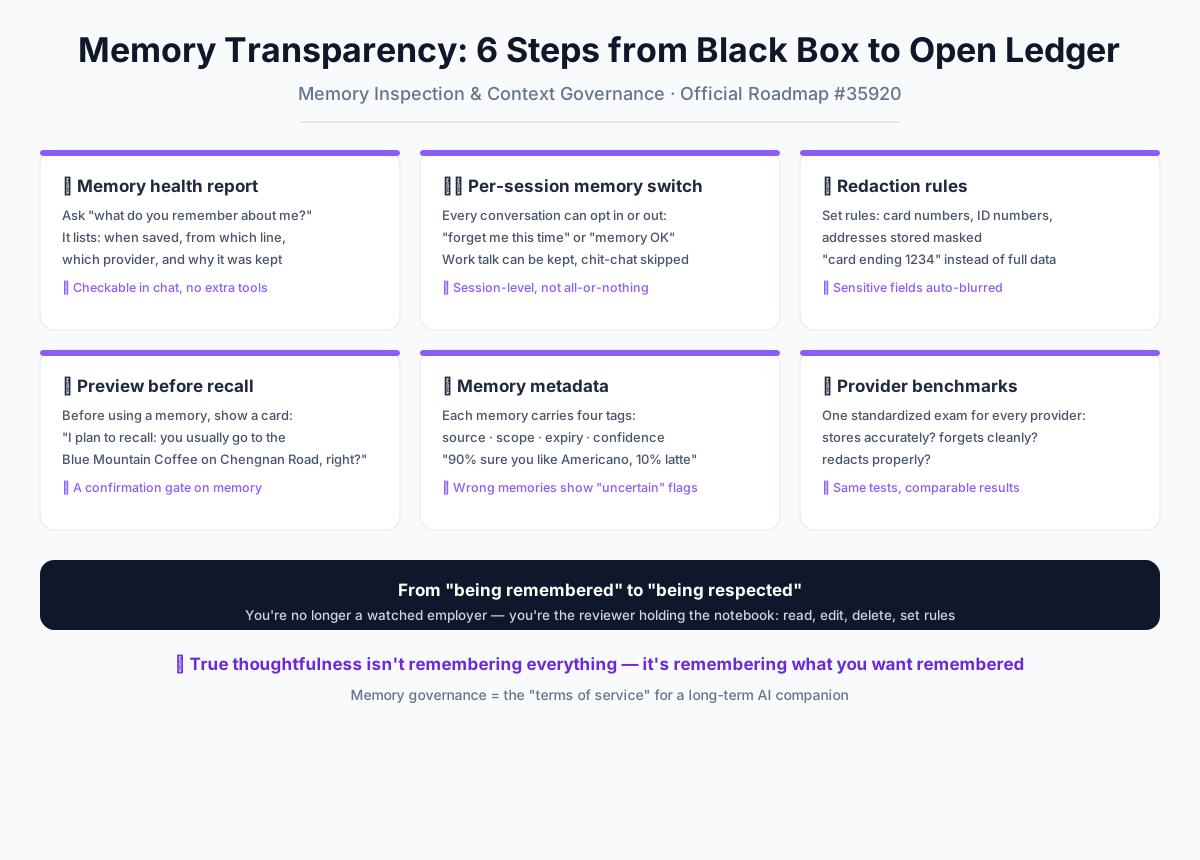
Picture a butler who remembers that you like warm milk, that you’re often late on Mondays, and that you’re allergic to peanuts. At first, this feels magical. But over time, curiosity turns to unease: What exactly is written in that notebook? Where did that guess come from? Why did they keep that? Can I tear out a page?
Right now, AI memory works like that butler’s locked drawer. You know it “remembers” things, but you can’t see the contents, trace the source, or delete a single entry. Hermes’ roadmap turns that notebook into a fishbowl: always visible, always manageable, and you can tell the butler, “Stop writing that down from now on.”
What the official plan includes: six concrete steps from black box to open ledger
First: a memory “health check” — the inspector.
You’ll be able to ask Hermes directly, “What do you remember about me?” and get a clear list: when each item was stored, which sentence it came from, which memory provider saved it, and why it was kept (e.g., “to remind you about your allergy”). Think of it as the butler laying the notebook flat on the table, every page stamped with date, source, and a margin note. The acceptance criterion here is crucial: you can inspect all of this inside the chat interface, with no extra tools or developer skills. Memory inspection shouldn’t be a privilege for technicians.
Second: a per-conversation “memory switch” — opt-in / opt-out.
Not every chat deserves to be remembered. The plan explicitly states that each session gets its own control: “Forget me this time” or “You may remember this one.” It’s like telling a waiter, “Don’t note my dietary restrictions today, I’m eating whatever.” This is per-session, not a global on/off—so work discussions can be remembered, while casual gossip stays off the record.
Third: adding “pixelation” — redaction rules.
Some information shouldn’t be stored in full, even if you allow memory. You’ll be able to set rules like “mask all bank card numbers, ID numbers, and exact street addresses.” Hermes will automatically replace sensitive fields with placeholders—e.g., “card ending in 1234.” The butler’s notebook now writes passwords as “****” — enough to trigger a reminder, never enough to leak the real thing.
Fourth: preview before injection — show recalled memory first.
When Hermes is about to use a memory in conversation (say you mention “the usual place,” and it wants to recall your favorite café), the interface will show a card before it acts: “I’m planning to recall: you usually go to Blue Mountain Coffee on South Road, correct?” Only after you confirm does it proceed. This is the butler asking, “I believe it was that place, wasn’t it?” before speaking aloud—a confirmation gate on every memory recall.
Fifth: a memory “ID card” — attached metadata.
Every stored memory will carry four small tags: source link (which conversation or webpage), scope (global or project-specific), expiration (e.g., “auto-forget next month”), and confidence (“I’m 90% sure you like Americano, 10% it might be latte”). This way, even when a memory is wrong, you can see the uncertainty marker instead of being silently misled. The butler’s notes now have footnotes: “This is a guess.”
Sixth: giving memory providers a “standardized exam” — benchmark suite.
Hermes memory can be powered by different providers (local models, cloud services, etc.). The roadmap demands a repeatable set of test fixtures to check each one: Does it store accurately? Does it forget cleanly when asked? Does it redact properly? The acceptance criterion: all providers run the same test data, and results can be compared side-by-side. Like energy-efficiency ratings for refrigerators—who keeps food fresh best, who wastes power, one test reveals all.
What it means for users: from “being remembered” to “being respected”
Taken together, these six items send a clear signal: AI memory is no longer a one-sided surveillance, but a negotiated agreement. You stop being the employer secretly observed by the butler. You become the reviewer who holds the notebook—able to flip pages, edit lines, delete entries, and set permissions.
In the short term, you gain peace of mind: sensitive information isn’t lying around naked, and the AI can’t confidently mix up your preferences. In the long term, this builds the trust foundation for AI’s “personality continuity.” Only when you know what it remembers and why it remembers it, can you safely let it accompany you for a year, five years, ten years. Memory governance, at its core, is the contract terms of long-term AI companionship.
This roadmap isn’t about making Hermes smarter at remembering. It’s about making Hermes remember more clearly—with your consent, your visibility, and your control. Because true thoughtfulness isn’t remembering everything. It’s remembering exactly what you’re willing to be remembered.
📖 Official Docs
This article is based on the official Hermes Agent documentation:GitHub ›/issues/35920