A2A Ecosystem Interop: AI Agents from Different Frameworks Can Finally Call Each Other
Hermes Messaging Platform Integration, Part 41: How the A2A Open Protocol Connects Agents Across Frameworks.
If every phone brand could only call its own brand, the telephone would have been obsolete long ago. AI agents face the same crisis — until the A2A protocol came along.
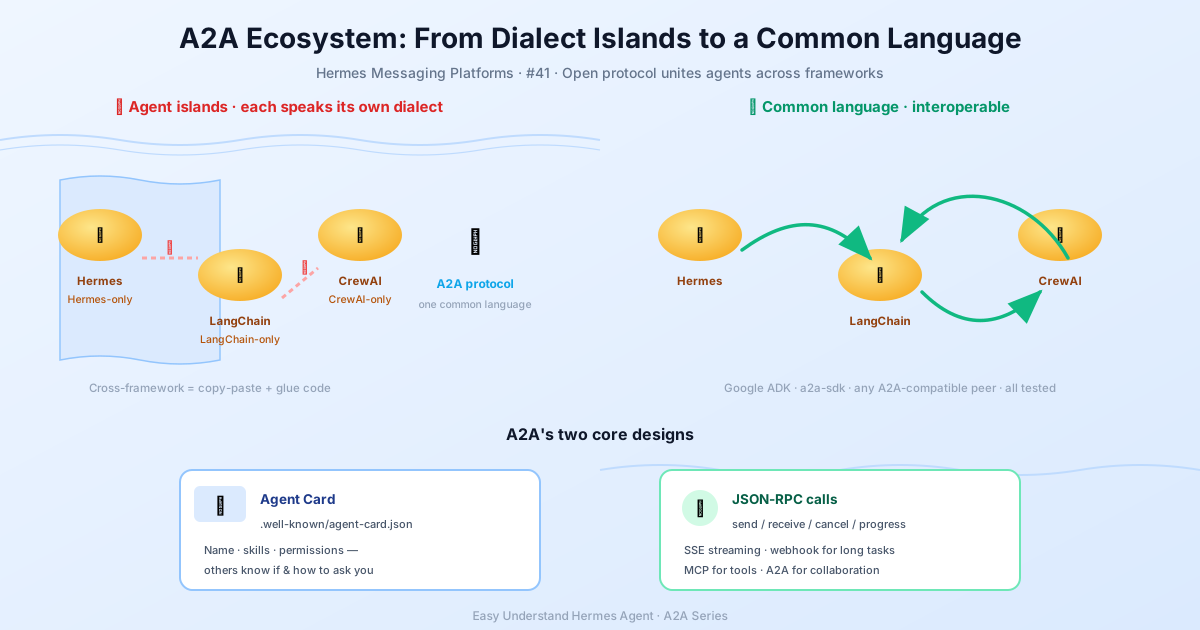
The Problem: Every Framework’s AI Speaks Its Own Dialect
Imagine this: you’ve got a Hermes agent at home, a LangChain-powered workflow bot at work, and a friend recommended a little CrewAI assistant. They’re all capable — but here’s the catch: they can’t understand each other.
It’s like China’s seven major dialect regions. Everyone can chat up a storm with people in their own village, but cross a village border and you’re lost. That’s exactly how today’s AI frameworks work: Hermes has its own way of talking, LangChain has its own interfaces, CrewAI has its own rules. Want Hermes to hand off a task to LangChain? Sorry — you’ll have to copy-paste manually or write a pile of glue code.
This is what we call “agent silos.” Each AI is smart on its own, but put them together and they become collectively clueless.
Why A2A Breaks Through: One Business Card + One Common Language
The A2A (Agent-to-Agent) protocol exists to solve this “cross-village communication” problem. It’s an open protocol initiated by Google and governed by the Linux Foundation, with open-source code (Apache 2.0) that no single company owns. What does that mean? It means it’s not some vendor’s proprietary play — it’s a “common language” everyone sat down and agreed on.
A2A’s core design is refreshingly down-to-earth, just two things:
First, the Agent Card. Every agent must publish a “business card” at a fixed location (.well-known/agent-card.json) that spells out: what I’m called, what I can do, what skills I have, what permissions I need. Anyone can look at the card and know whether to ask for help and how to ask. It’s like getting a business card from someone at a partner company — one glance at the title and you know whether they’re the right person to talk to.
Second, standard JSON-RPC 2.0 calls. All agents communicate over a unified “phone line” — sending messages, receiving messages, canceling tasks, checking progress — all standard operations. It also supports SSE streaming, so it works like a phone call: the other side says a sentence, you hear it in real time, no need to wait for the whole long speech to finish before reacting. Long-running tasks can also push notifications via webhook — it’ll ping you when it’s done, so you don’t have to sit there watching.
This design makes A2A perfectly complementary to another hot protocol, MCP: MCP answers “what tools can I use,” A2A answers “who can help me get this done.” One handles tools, the other handles collaboration.
Ecosystem Overview: Who Can You Interop With?
The official docs are crystal clear: Hermes’s A2A plugin can interoperate with any A2A-compatible peer. That means:
- Another Hermes (of course)
- LangChain agents (yes)
- CrewAI agents (yes)
- Google’s ADK agents (yes)
- Anything built with the official a2a-sdk (yes)
And this interop isn’t just theoretical — it’s been verified with the official Python a2a-sdk: agent card parsing, message sending, streaming conversations — all working end to end.
Real-World Cases: Cross-Framework Collaboration Already Happening
Case 1: Hermes + OpenClaw Same-Machine Communication (GitHub issue #42747)
A user was running both Hermes and OpenClaw on the same Mac, with both agents connected to Telegram. But Telegram has an annoying limitation: bots in a group can’t see each other’s messages. So these two AIs were living under the same roof, yet could only communicate through the user manually relaying messages.
This is a textbook A2A scenario: let Hermes directly delegate tasks to OpenClaw’s skills, and vice versa, completely bypassing Telegram and the human middleman. Agents call each other directly, no switchboard operator needed.
Case 2: Gotong Integration Proposal (#58325)
Gotong is a self-hosted workflow orchestration platform — basically a “project manager” for agents. The proposal goes like this: Hermes handles personal memory, reasoning, and decision-making, while Gotong handles the governed collaboration layer — task scheduling, human approvals, full audit trails. The two connect via A2A endpoints, each doing what it does best.
Case 3: Zero-Intrusion Enterprise Collaboration (#67951)
Someone proposed a lighter-weight transitional approach: build a collaboration pack entirely using Hermes’s Skill mechanism. Agents invoke shell scripts through terminal tools, and the scripts talk to a central Hub over HTTP. Zero code changes needed to achieve multi-agent collaboration. It’s a “temporary footbridge” before A2A officially lands.
What This Means for Users
The interoperability that A2A brings is very tangible for everyday users:
You no longer have to pick a side. Using Hermes today, want to try CrewAI tomorrow? No problem — they can talk to each other, and your data, tasks, and context flow seamlessly between them.
Your agent is no longer a lone wolf. When one agent can’t handle something, it can “call in backup” — discovering another agent with the right skills via A2A and delegating the task. It’s like when you hit something at work you don’t understand: you go straight to the colleague who knows, instead of routing everything through the boss.
The ecosystem keeps growing. Because the protocol is open and neutral, any framework can plug in. Today it connects to LangChain; tomorrow it might connect to your company’s in-house agent — as long as it follows the A2A standard.
One-line summary: A2A turns AI agents from “dialect islands” into a “Mandarin-speaking community.” Your AI is no longer an island — it’s a node in a vast collaboration network where it can always find a helping hand, and be found by others in return.
📖 Official Docs
This article is based on the official Hermes Agent documentation:Official docs › user-guide/messaging/a2a